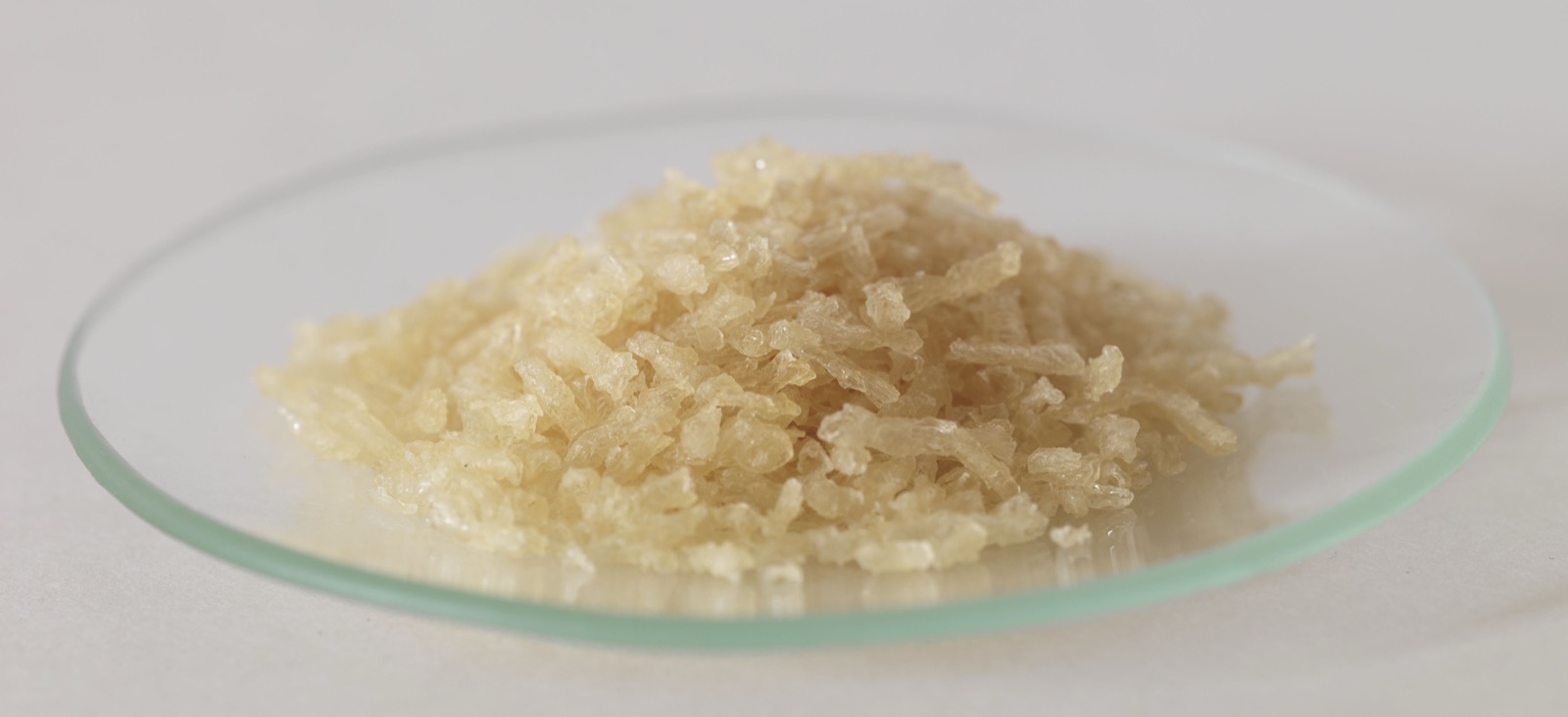
Undenatured Type II Collagen
Native, non-hydrolysed type II collagen from chicken sternal cartilage, processed cold to keep the triple helix intact. Total collagen typically 25% or more, with the undenatured fraction declared by ELISA per batch.
Specifications
| Ingredient identity | Standardised cartilage concentrate in which type II collagen is retained in its native triple-helical form; non-hydrolysed, non-gelatinised, not a collagen peptide |
| Source and animal origin | Chicken (Gallus gallus) sternal cartilage. Poultry-derived; not bovine, porcine, marine, insect or plant |
| CAS number | 9007-34-5 - the generic collagen identifier used on trade documents. The concentrate is not a separate chemically defined compound |
| Appearance and odour | Off-white to light-yellow free-flowing powder with a mild characteristic odour |
| Total collagen | Typically not less than 25%, determined from hydroxyproline; the basis for the 40 mg serving that delivers about 10 mg total collagen |
| Undenatured type II collagen | Declared per batch by ELISA against intact native epitopes. Commercial material ranges roughly 3% to 10%; there is no industry-wide standard, so specify your minimum |
| Assay and identity methods | ELISA for epitope-intact collagen; SDS-PAGE for chain profile and hydroxyproline for total collagen; thermal checks confirm the helix has not been denatured |
| Co-extractives | Chondroitin sulphate and hyaluronic acid occur naturally in the cartilage matrix and are carried through; present but not standardised or claimed |
| Solubility and thermal handling | Dispersible rather than freely soluble in cold water. Must not be heated - hot-fill, extrusion and baking denature the helix and destroy the ELISA value |
| Moisture and particle size | Moisture typically not more than 10%; low-temperature drying and milling. Typically 95% through 80 mesh; capsule and direct-compression cuts available |
| Typical use level | 40 mg of standardised cartilage per daily serving in most finished products; higher levels used where a specific ELISA minimum is targeted |
| Contaminant and microbiological testing | Lead, arsenic, cadmium and mercury plus total plate count, yeast and mould, E. coli and Salmonella tested each lot to the agreed specification; limits stated on the batch CoA |
| Allergen, diet and origin status | Poultry-derived - not vegan or vegetarian. Chicken is not a listed major allergen in the US or EU but must be declared as species. Free of milk, egg, soy, fish, crustacean… |
| Shelf life, storage | 24 months in unopened original packaging below 25 degrees C, protected from heat and humidity. |
| HS code | 3504 00 99 |
Applications
Available grades
Standard supplement grade standardised on total collagen with the undenatured ELISA figure declared per batch; higher-ELISA grades produced to order against a written minimum. Supplied as neat cartilage concentrate, or pre-blended on a maltodextrin or microcrystalline cellulose carrier for direct compression and capsule uniformity. Pet-grade material available at wider particle-size tolerance. Halal and kosher certification subject to flock slaughter documentation.
Related products
Glucosamine Sulphate (Potassium Chloride Salt)
Stabilised glucosamine sulphate potassium chloride double salt, (C6H14NO5)2SO4·2KCl, assayed 98.0-102.0% to the USP monograph. Shellfish-derived or non-animal fermentation grades, 25 kg drums, ex-India.
Glucosamine Hydrochloride
D-Glucosamine hydrochloride, CAS 66-84-2, USP assay 98.0-102.0% on the dried basis - the highest glucosamine base loading of the common salts at 83.1%. Crustacean or vegan fermentation grades, 25 kg drums.
Chondroitin Sulphate Sodium
Chondroitin sulphate sodium, a sulphated glycosaminoglycan from bovine, porcine, avian or marine cartilage. USP assay 90.0-105.0% on the dried basis with electrophoretic purity checked. 25 kg drums, ex-India.