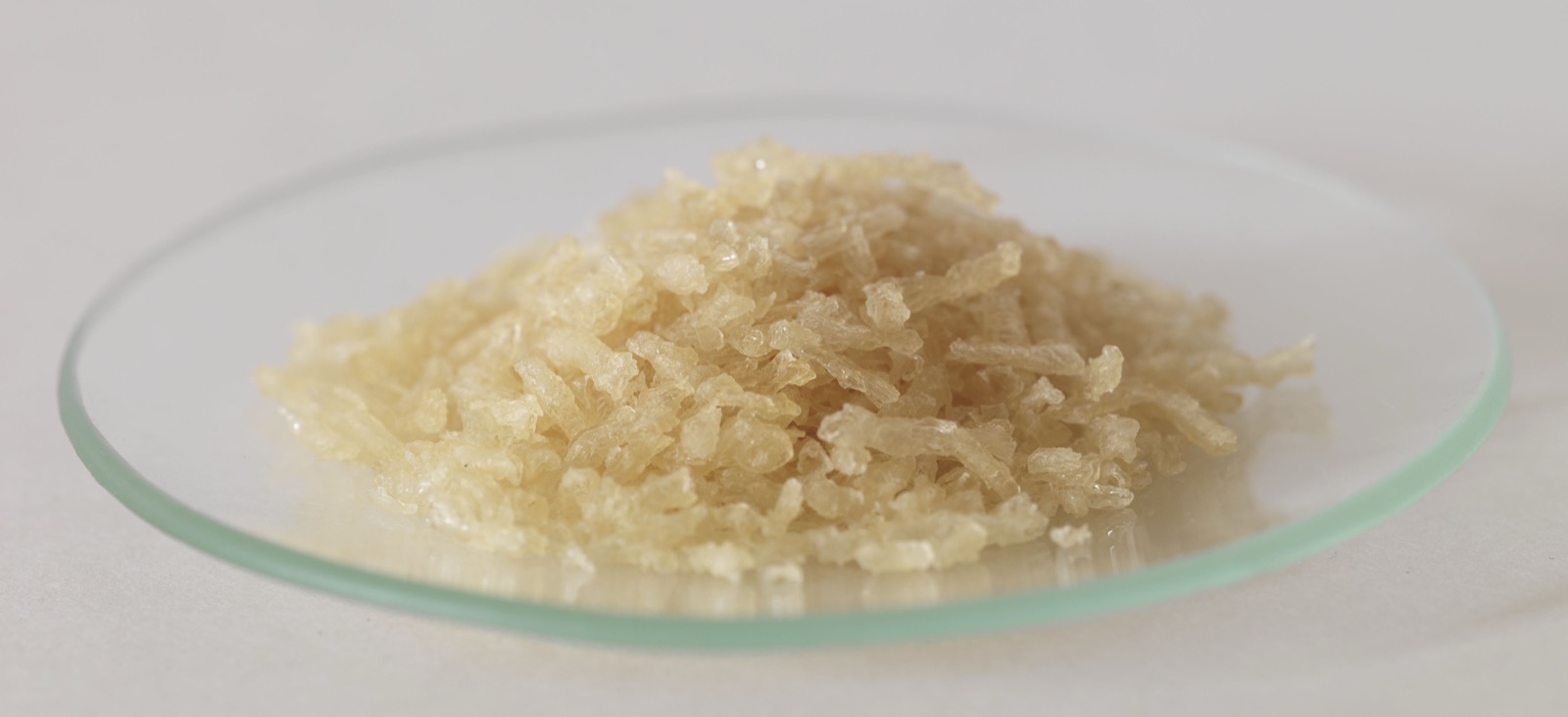
Chondroitin Sulphate Sodium
Chondroitin sulphate sodium, a sulphated glycosaminoglycan from bovine, porcine, avian or marine cartilage. USP assay 90.0-105.0% on the dried basis with electrophoretic purity checked. 25 kg drums, ex-India.
Specifications
| Definition | Sodium salt of the sulphated linear glycosaminoglycan obtained from bovine, porcine or avian cartilage (USP); a separate USP article covers shark material. |
| Repeat unit | Alternating D-glucuronic acid and N-acetyl-D-galactosamine, beta-1,3 and beta-1,4 linked, sulphated mainly at C-4 (type A) and C-6 (type C) |
| CAS number | 9082-07-9 for the sodium salt; 9007-28-7 is used for chondroitin sulphate generally |
| Molecular mass | Chains run past 100 sugar units; terrestrial material typically below 45 kDa, shark-derived material up to around 70 kDa |
| Assay | 90.0-105.0% chondroitin sulphate sodium on the dried basis, USP, by CPC titration |
| Specific rotation | -20.0° to -30.0° (USP) |
| pH | 5.5 to 7.5 in a 1 in 100 aqueous solution (USP) |
| Loss on drying | Not more than 10.0% (105 °C, 4 hours). Strongly hygroscopic - reseal the liner immediately after sampling. |
| Residue on ignition | 20.0-30.0% on the dried basis; the sodium and the sulphate esters are part of the molecule, not contamination |
| Protein and inorganic limits | Protein not more than 6.0% on the dried basis; chloride not more than 0.50%; sulphate not more than 0.24%; heavy metals not more than 20 ppm (USP) |
| Electrophoretic purity | Not more than 2% of any individual impurity - the test that catches oversulphated chondroitin, keratan and other polyanion adulterants |
| Microbiology | Total aerobic count not more than 1000 cfu/g; yeast and mould not more than 100 cfu/g; Salmonella and E. coli absent (USP) |
| Origin, allergen and diet status | Animal cartilage only, never vegan or vegetarian. Porcine excludes halal and kosher; avian suits both with certification; shark or fish material must declare fish. |
| Shelf life, storage | 24-36 months sealed in the original drum below 25 °C at low humidity. |
| HS code | 3913 90 90 |
Applications
Available grades
USP-compliant 90% CPC assay bovine grade as standard; higher 95% CPC grades; avian (chicken sternal cartilage) for halal and kosher programmes; porcine; marine shark material to the separate USP shark article; low-molecular-weight fractions; 80 and 100 mesh.
Related products
Glucosamine Sulphate (Potassium Chloride Salt)
Stabilised glucosamine sulphate potassium chloride double salt, (C6H14NO5)2SO4·2KCl, assayed 98.0-102.0% to the USP monograph. Shellfish-derived or non-animal fermentation grades, 25 kg drums, ex-India.
Glucosamine Hydrochloride
D-Glucosamine hydrochloride, CAS 66-84-2, USP assay 98.0-102.0% on the dried basis - the highest glucosamine base loading of the common salts at 83.1%. Crustacean or vegan fermentation grades, 25 kg drums.
MSM (Methylsulfonylmethane)
Bulk methylsulfonylmethane (dimethyl sulfone, CAS 67-71-0) at 99.9% chromatographic purity, residual DMSO under 0.1%, in mesh cuts from coarse granular to fine powder. Fully synthetic, vegan and allergen-free.