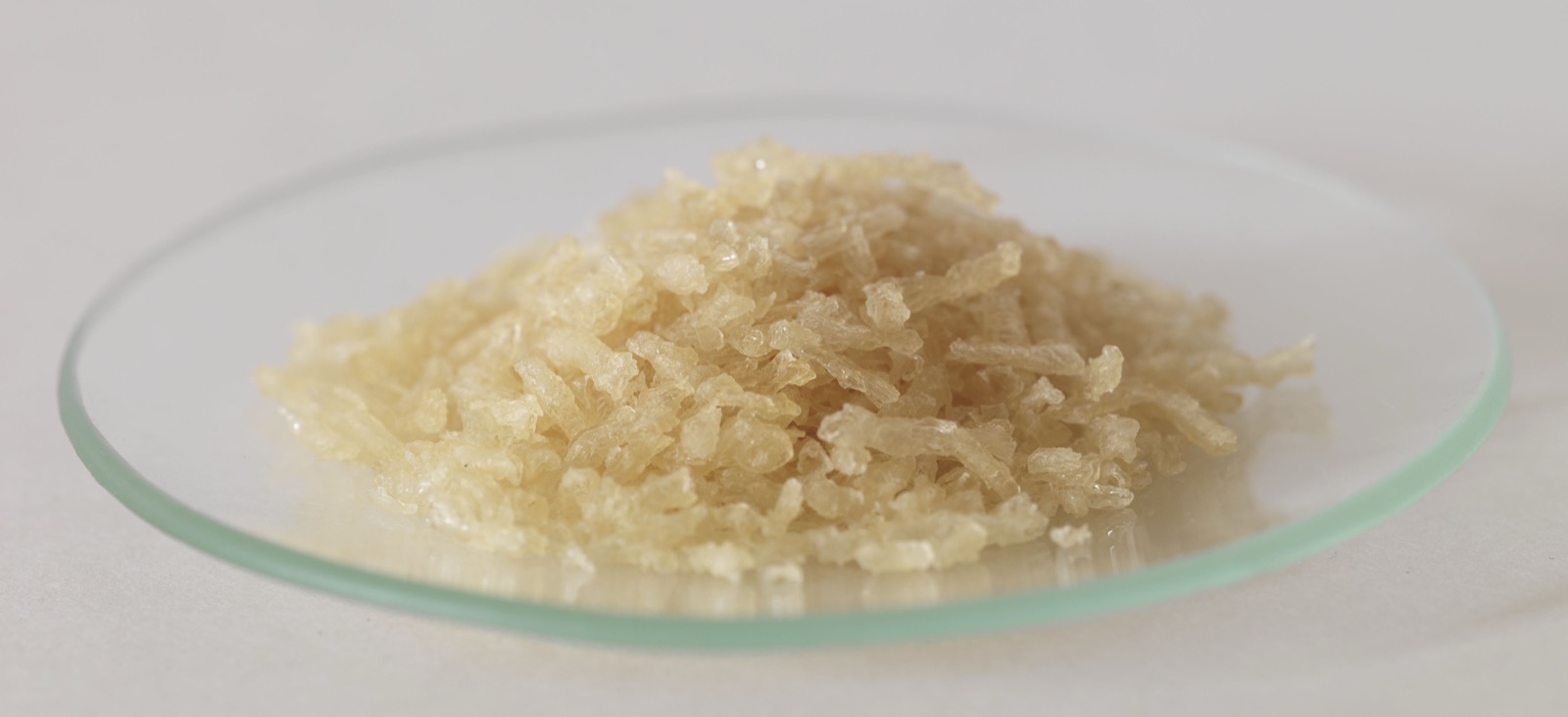
Glucosamine Hydrochloride
D-Glucosamine hydrochloride, CAS 66-84-2, USP assay 98.0-102.0% on the dried basis - the highest glucosamine base loading of the common salts at 83.1%. Crustacean or vegan fermentation grades, 25 kg drums.
Specifications
| Chemical name | 2-Amino-2-deoxy-D-glucose hydrochloride (D-glucosamine hydrochloride) |
| Molecular formula and weight | C6H13NO5·HCl; 215.63 g/mol |
| CAS number | 66-84-2 |
| Assay | 98.0-102.0% C6H13NO5·HCl on the dried basis, USP dietary supplement monograph |
| Glucosamine base equivalent | 83.1% theoretical (179.17 of 215.63), the highest base loading of the common salts; chloride accounts for the remaining 16.4% |
| Specific rotation | +70.0° to +73.0° (USP, on an equilibrated solution after mutarotation) |
| pH | 3.0 to 5.0 in a 20 mg/mL aqueous solution (USP) |
| Appearance and solubility | White crystalline powder, practically odourless; freely soluble in water, practically insoluble in ethanol (96%) |
| Loss on drying and ash | Loss on drying not more than 1.0% (105 °C, 2 hours); residue on ignition not more than 0.1%, so no ash burden on the label |
| Sulphate | Not more than 0.24% (USP limit test) |
| Arsenic and heavy metals | Arsenic not more than 3 ppm (Method II); heavy metals not more than 10 ppm (USP Method II); full elemental impurity panel on request |
| Origin, allergen and diet status | Shrimp and crab shell chitin route: declare crustacean allergen, non-vegan. Aspergillus niger fermentation on plant glucose: non-animal, shellfish-free, vegan. |
| Particle size and handling | 30, 40, 60 and 80 mesh standard. Hygroscopic and a reducing amino sugar - it browns with heat and moisture, so trial wet granulation and hot-fill liquids. |
| Shelf life, storage | 36 months sealed, below 25 °C at low humidity. |
| HS code | 2932 99 00 |
Applications
Available grades
USP dietary supplement grade as standard; crustacean-derived (shrimp and crab chitin) and non-animal Aspergillus niger fermentation streams; 30, 40, 60 and 80 mesh; granular direct-compression grade; kosher and halal certified lots on request.
Related products
Glucosamine Sulphate (Potassium Chloride Salt)
Stabilised glucosamine sulphate potassium chloride double salt, (C6H14NO5)2SO4·2KCl, assayed 98.0-102.0% to the USP monograph. Shellfish-derived or non-animal fermentation grades, 25 kg drums, ex-India.
Chondroitin Sulphate Sodium
Chondroitin sulphate sodium, a sulphated glycosaminoglycan from bovine, porcine, avian or marine cartilage. USP assay 90.0-105.0% on the dried basis with electrophoretic purity checked. 25 kg drums, ex-India.
MSM (Methylsulfonylmethane)
Bulk methylsulfonylmethane (dimethyl sulfone, CAS 67-71-0) at 99.9% chromatographic purity, residual DMSO under 0.1%, in mesh cuts from coarse granular to fine powder. Fully synthetic, vegan and allergen-free.