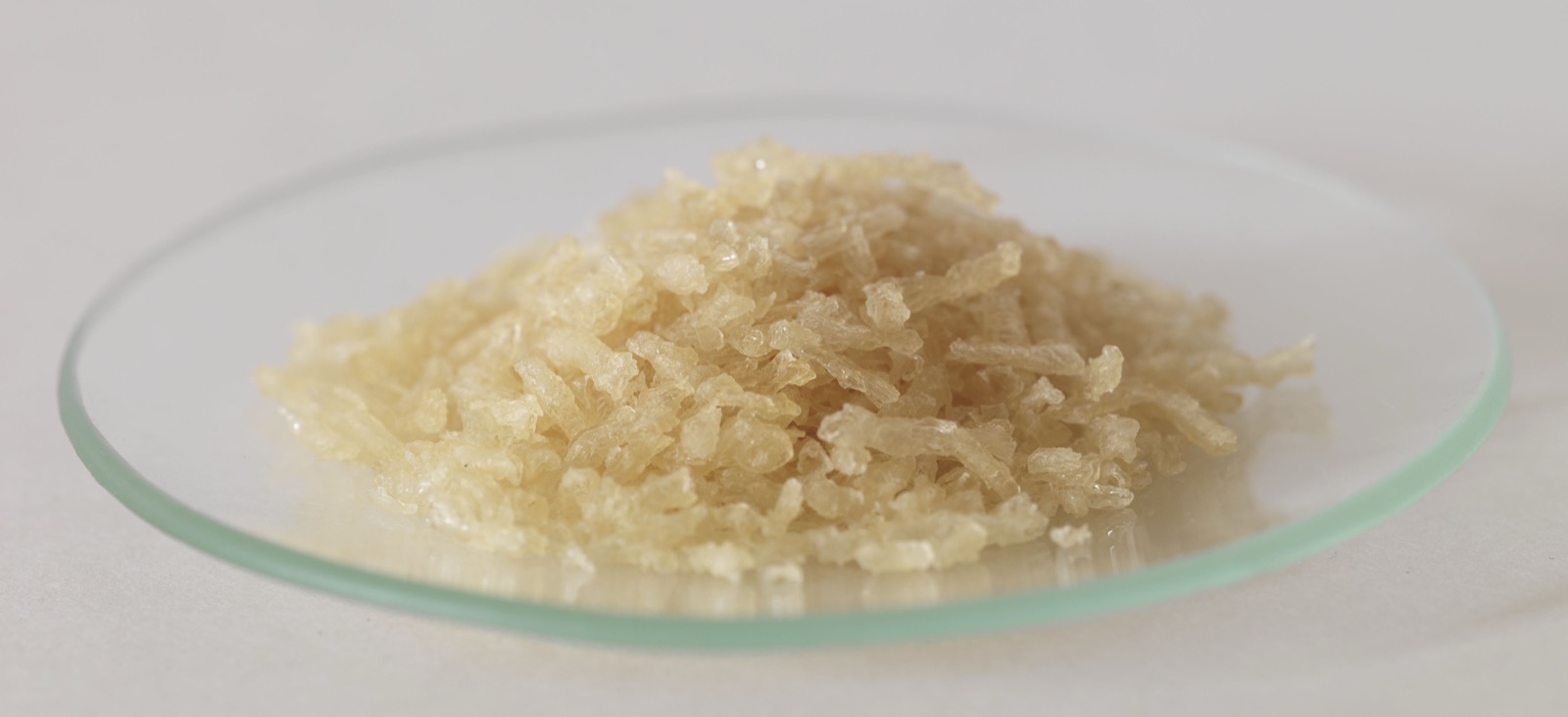
MSM (Methylsulfonylmethane)
Bulk methylsulfonylmethane (dimethyl sulfone, CAS 67-71-0) at 99.9% chromatographic purity, residual DMSO under 0.1%, in mesh cuts from coarse granular to fine powder. Fully synthetic, vegan and allergen-free.
Specifications
| Chemical name and synonyms | Methylsulfonylmethane; also dimethyl sulfone, methyl sulfone, DMSO2, sulfonylbismethane, (methanesulfonyl)methane |
| CAS / EC number | CAS 67-71-0; EC (EINECS) 200-665-9; ECHA InfoCard 100.000.605 |
| Molecular formula and weight | C2H6O2S, (CH3)2SO2; molar mass 94.13 g/mol |
| Appearance and odour | White to off-white crystalline powder or granules; odourless, slightly bitter-sulfurous taste |
| Assay (titrimetric) | 98.0 - 102.0% on an as-is basis |
| Chromatographic purity and impurities | Not less than 99.9%; residual DMSO not more than 0.1%; any single impurity not more than 0.05%; total impurities not more than 0.20% |
| Melting range | 108.5 - 110.5 degrees C typical commercial specification; literature value 107 - 109 degrees C |
| Water and residue on ignition | Water by Karl Fischer not more than 0.10%; residue on ignition not more than 0.10%. Loss on drying is unreliable as MSM volatilises on heating |
| Heavy metals | Not more than 3 ppm as Pb; individual Pb, As, Cd and Hg limits reported per batch |
| Solubility | Freely soluble in water, approximately 187 g/L at 30 degrees C; soluble in ethanol and in hot organic solvents |
| Particle size and bulk density | Standard cuts 10-40, 40-80 and 80-200 mesh; bulk density above 0.65 g/mL |
| Microbiological limits | Aerobic plate count below 10 cfu/g; yeast and mould below 10 cfu/g; coliforms, E. coli and Salmonella negative |
| Allergen, diet and origin status | Synthetic, non-animal. Suitable for vegan and vegetarian labelling. Free of milk, egg, soy, fish, crustacean, gluten and tree-nut material; non-GMO |
| Shelf life, storage | 36 months in unopened original packaging, stored cool, dry and away from direct heat. |
| HS code | 2930 90 99 |
Applications
Available grades
Supplement and food grade at not less than 99.9% chromatographic purity, purified by multi-stage distillation or by crystallisation; distilled material is preferred where residual DMSO and odour must be lowest. Mesh cuts: coarse granular 10-40, regular 40-80, fine 80-200 for direct compression, capsule filling and beverage use. Material conforming to the USP dietary-supplement standard is available on request (USP maintains a methylsulfonylmethane reference standard, catalogue 1437600). Technical and solvent grade also offered.
Related products
Glucosamine Sulphate (Potassium Chloride Salt)
Stabilised glucosamine sulphate potassium chloride double salt, (C6H14NO5)2SO4·2KCl, assayed 98.0-102.0% to the USP monograph. Shellfish-derived or non-animal fermentation grades, 25 kg drums, ex-India.
Glucosamine Hydrochloride
D-Glucosamine hydrochloride, CAS 66-84-2, USP assay 98.0-102.0% on the dried basis - the highest glucosamine base loading of the common salts at 83.1%. Crustacean or vegan fermentation grades, 25 kg drums.
Chondroitin Sulphate Sodium
Chondroitin sulphate sodium, a sulphated glycosaminoglycan from bovine, porcine, avian or marine cartilage. USP assay 90.0-105.0% on the dried basis with electrophoretic purity checked. 25 kg drums, ex-India.