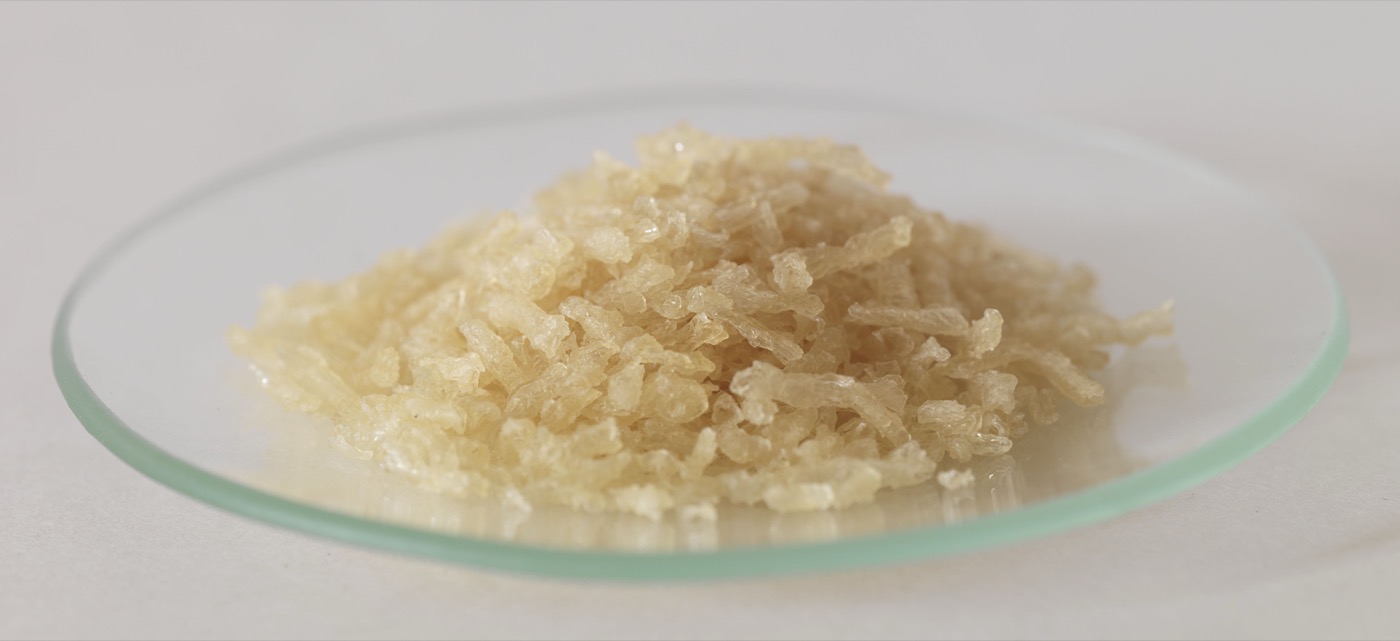
Hydrolysed Collagen Peptides
Collagen hydrolysate, CAS 92113-31-0 — protein NLT 90% on dry basis at nitrogen factor 5.55, average peptide MW 1000–3000 Da, cold-water soluble. Bovine, porcine, marine and avian type II grades. Not vegan.
Specifications
| Chemical identity | Collagen hydrolyzates (hydrolysed collagen), CAS 92113-31-0, EC 295-635-5. A peptide mixture from partial hydrolysis of collagen, not a single defined compound. |
| Source and collagen type | Standard: bovine hide, type I with type III. Also bovine bone (ossein), porcine skin, fish skin (marine type I) and chicken sternal cartilage (type II). |
| Protein content | NLT 90% on dry basis by Kjeldahl using nitrogen factor 5.55; premium bovine hide grades run above 94%. Do not calculate at 6.25 — it overstates protein by about 12%. |
| Average molecular weight | 1000–3000 Da standard, by viscosity or GPC; 2000–5000 Da coarse grades to order. Governs cold solubility, viscosity and absence of gelling. |
| Collagen markers | Glycine near one third of residues; hydroxyproline roughly 8–10% of total amino acids, used as the authenticity marker. Tryptophan absent, so protein is incomplete. |
| Appearance and solution | Off-white to pale yellow powder or granulate, bland odour. Cold-water soluble, non-gelling. pH 5.0–6.5 (10% solution); viscosity 2.0 ± 0.5 mPa·s at 10%. |
| Physical limits | Loss on drying NMT 8.0%; ash NMT 2.0%; turbidity NMT 50 FTU on the clear-beverage grade. Granulated instant grade offered for cold-water dispersion. |
| Process residues | Sulphites (as SO2) NMT 10 ppm and peroxides (as H2O2) NMT 10 ppm — the SO2 limit keeps the material below the EU 10 mg/kg sulphite declaration threshold. |
| Heavy metals | Arsenic NMT 1 ppm, lead NMT 5 ppm, cadmium NMT 0.5 ppm, mercury NMT 0.15 ppm, chromium NMT 10 ppm, copper NMT 30 ppm, zinc NMT 30 ppm (GME methods). |
| Microbiology | Total aerobic count NMT 1000 cfu/g; yeast and mould NMT 100 cfu/g; sulphite-reducing anaerobic spores NMT 10 cfu/g; E. coli absent in 10 g; Salmonella absent in 25 g. |
| Allergen status | Free from milk, egg, soy, gluten, peanut, tree nut and crustacean. The fish-skin grade IS a declarable fish allergen (EU 1169/2011 Annex II, US FALCPA). |
| Dietary and origin status | Animal origin — not vegan or vegetarian. Bovine hide standard, halal and kosher certifiable; porcine grade is neither; fish grade marine; type II grade avian. |
| Animal by-product controls | Raw material from animals passed fit for human consumption; produced to Reg. (EC) 853/2004 Annex III Sections XIV and XV; BSE/TSE origin certificate per consignment. |
| Shelf life, storage | 36 months unopened below 25 °C and 60% RH, away from light; hygroscopic once opened. |
| HS code | 35040010 |
Applications
Available grades
Bovine hide type I/III (standard); bovine bone ossein; porcine skin; fish skin marine type I (fish allergen); chicken sternal cartilage hydrolysed type II. Molecular weight variants at 1000–3000 Da and 2000–5000 Da; granulated instant grade; low-turbidity clear-beverage grade; halal and kosher certified bovine lots.
Related products
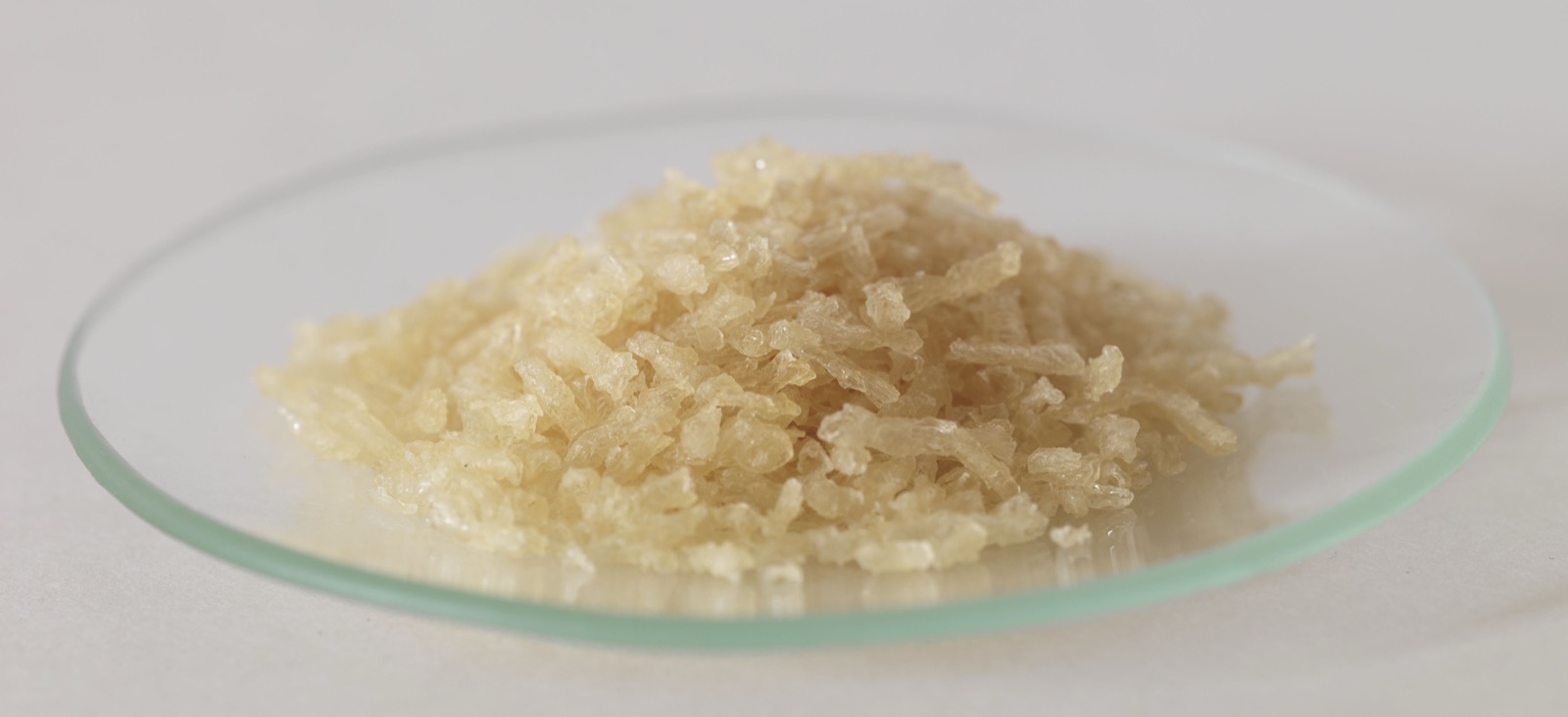
Glucosamine Sulphate (Potassium Chloride Salt)
Stabilised glucosamine sulphate potassium chloride double salt, (C6H14NO5)2SO4·2KCl, assayed 98.0-102.0% to the USP monograph. Shellfish-derived or non-animal fermentation grades, 25 kg drums, ex-India.
Glucosamine Hydrochloride
D-Glucosamine hydrochloride, CAS 66-84-2, USP assay 98.0-102.0% on the dried basis - the highest glucosamine base loading of the common salts at 83.1%. Crustacean or vegan fermentation grades, 25 kg drums.
Chondroitin Sulphate Sodium
Chondroitin sulphate sodium, a sulphated glycosaminoglycan from bovine, porcine, avian or marine cartilage. USP assay 90.0-105.0% on the dried basis with electrophoretic purity checked. 25 kg drums, ex-India.