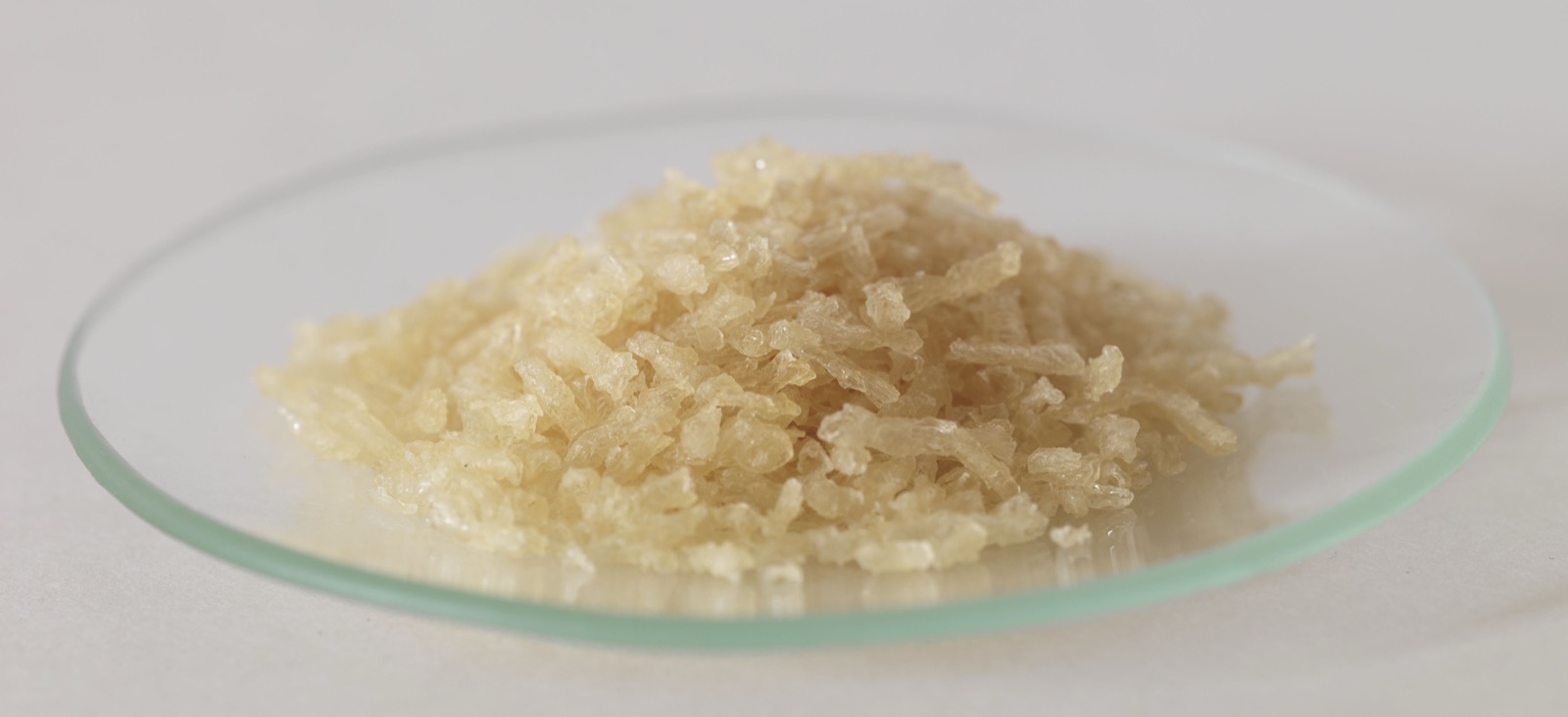
Hyaluronic Acid (Sodium Hyaluronate)
Fermentation-derived sodium hyaluronate (CAS 9067-32-7), non-animal and vegan, supplied in molecular-weight grades from sub-10 kDa oligo fractions to over 1,800 kDa. Food, cosmetic and Ph. Eur. quality.
Specifications
| Chemical identity and CAS | Sodium salt of hyaluronic acid, a linear glycosaminoglycan. CAS 9067-32-7 (sodium hyaluronate); CAS 9004-61-9 (hyaluronic acid free acid) |
| Repeating unit | (C14H20NNaO11)n - alternating D-glucuronic acid and N-acetyl-D-glucosamine; disaccharide repeat mass 401.3 Da |
| Source and production | Fermentation of a non-GMO Streptococcus equi subsp. zooepidemicus strain; cells inactivated and removed, then filtration, ultrafiltration, solvent precipitation and drying |
| Appearance | White to almost white powder, granules or fibrous aggregate; very hygroscopic |
| Assay - food and cosmetic grade | Sodium hyaluronate not less than 91.0%; D-glucuronic acid not less than 44.0% by the carbazole method |
| Assay - Ph. Eur. grade | 95.0 - 105.0% calculated on the dried substance; intrinsic viscosity 90 - 120% of the value stated on the label |
| Molecular weight grades | Oligo/ultra-low below 10 kDa; low 10 - 500 kDa; medium 500 - 1,000 kDa; high above 1,000 kDa up to more than 1,800 kDa. Declared per batch |
| Protein and nucleic acids | Protein not more than 0.1% food grade; Ph. Eur. not more than 0.3% (0.1% for parenteral use). Nucleic acids: absorbance at 260 nm not more than 0.5 |
| Loss on drying and pH | Loss on drying not more than 10.0% food grade (Ph. Eur. not more than 20.0%); pH 6.0 - 8.0 at 5 mg/mL (Ph. Eur. 5.0 - 8.5) |
| Heavy metals and arsenic | Heavy metals not more than 20 ppm (Ph. Eur. 10 ppm where intended for parenterals); arsenic not more than 2 ppm |
| Solubility | Freely soluble in water giving clear, viscous solutions; practically insoluble in ethanol, acetone and most organic solvents |
| Microbiological limits | Total plate count not more than 500 cfu/g; yeast and mould not more than 100 cfu/g; pathogens absent. Endotoxin testing on pharmacopoeial grades |
| Allergen, diet and origin status | Bacterial fermentation, non-animal; vegan and vegetarian suitable. Free of milk, egg, fish, crustacean, gluten and tree-nut material. Rooster-comb HA is avian - specify origin |
| Shelf life, storage | 24 - 36 months in sealed foil with desiccant, below 25 degrees C, protected from moisture and light. |
| HS code | 3913 90 90 |
Applications
Available grades
Food and oral supplement grade (non-animal, fermentation) at not less than 91.0% sodium hyaluronate; cosmetic grade to the same purity with viscosity and clarity tuned for topical work; pharmacopoeial grade to the Ph. Eur. sodium hyaluronate monograph, with a separate parenteral-intent specification carrying tighter protein, heavy metal and endotoxin limits. Molecular-weight cuts: oligo/ultra-low below 10 kDa, low 10-500 kDa, medium 500-1,000 kDa, high above 1,000 kDa. Free-acid hyaluronic acid supplied on request; kosher and halal certified material available.
Related products
Glucosamine Sulphate (Potassium Chloride Salt)
Stabilised glucosamine sulphate potassium chloride double salt, (C6H14NO5)2SO4·2KCl, assayed 98.0-102.0% to the USP monograph. Shellfish-derived or non-animal fermentation grades, 25 kg drums, ex-India.
Glucosamine Hydrochloride
D-Glucosamine hydrochloride, CAS 66-84-2, USP assay 98.0-102.0% on the dried basis - the highest glucosamine base loading of the common salts at 83.1%. Crustacean or vegan fermentation grades, 25 kg drums.
Chondroitin Sulphate Sodium
Chondroitin sulphate sodium, a sulphated glycosaminoglycan from bovine, porcine, avian or marine cartilage. USP assay 90.0-105.0% on the dried basis with electrophoretic purity checked. 25 kg drums, ex-India.