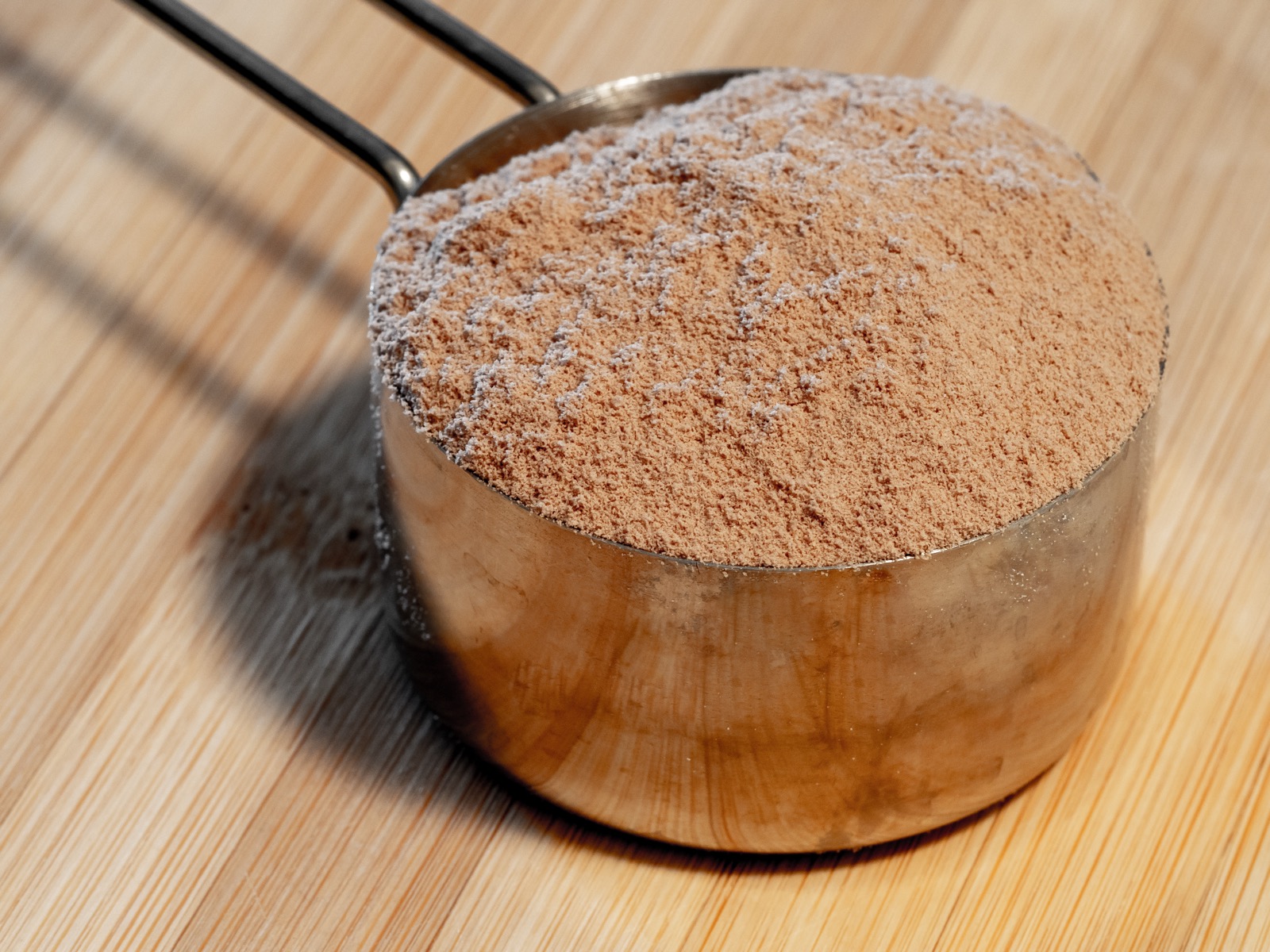
Casein (micellar)
Native micellar casein from bovine skim milk, concentrated by microfiltration and low-heat spray dried. MCC 80, MCC 85 and isolate grades, 79.5-89.5% protein. Milk allergen. Bulk export from India.
Specifications
| Source | Bovine skim milk, pasteurised. Concentrated from milk by membrane filtration only — under the ADPI standard it may not be made by blending separate casein and whey ingredients. |
| Protein content (dry basis) | MCC 85: min 85.0% dry basis. MCC 80: min 79.5% as-is. Micellar casein isolate: min 89.5% dry basis. Nitrogen x 6.38, per the ADPI standard. |
| Appearance | Off-white to light cream free-flowing spray-dried powder. Clean, bland dairy flavour and odour; no cooked or acid notes. |
| Solubility | Micelles (about 50-500 nm) disperse colloidally rather than dissolve. Isoelectric point pH 4.6, so it precipitates in acid systems. Instantised grades take cold water. |
| Moisture | Max 6.0% for MCC 80 and MCC 85; max 7.0% for micellar casein isolate (ADPI Concentrated Milk Proteins Standard v2.1). |
| Fat | Max 3.0% under the ADPI limit for microfiltered milk protein and micellar casein grades. Typical lots run well below this. |
| Ash | Max 8.0%. Ash is largely colloidal calcium phosphate held inside the micelle, which is why calcium runs high in this ingredient. |
| Lactose | Max 10.0% in MCC 80, 3.0% in MCC 85 and 1.0% in the isolate. None of these grades is lactose-free. |
| Particle size | Spray-dried; regular grade is a fine powder, instantised grade is agglomerated to a coarser cut for cold water. Sieve profile agreed per contract. |
| Amino acid profile note | Complete dairy protein, PDCAAS 1.0. High in glutamine and proline; phosphoserine residues bind calcium. Full amino acid table issued per lot on request. |
| Processing method | Pasteurised skim milk microfiltered at about 0.1 micron, diafiltered to strip lactose and serum minerals, then low-heat spray dried. No acid or rennet step. |
| Allergen status | MILK allergen. Declare as milk and products thereof (EU 1169/2011 Annex II) and as milk (US FALCPA). Lecithin-instantised grades add a soy declaration in the EU. |
| Shelf life | Typically 24 months from manufacture, unopened, stored below 25 C at under 65% RH. Keep away from strong odours; the powder picks up flavour. |
| HS code | 3501 10 00 (India ITC-HS) — Casein. 18% GST domestically, export policy free. Lecithin-instantised grades classify at 3504 00; blended premixes at 2106 10. |
Applications
Available grades
MCC 80 (min 79.5% protein as-is), MCC 85 (min 85.0% dry basis) and Micellar Casein Isolate / MCI (min 89.5% dry basis). Regular and instantised (lecithinated) versions — note that lecithin-instantised material carries a soy declaration in the EU and normally classifies at 3504 rather than 3501. Kosher and Halal certification on request; as a dairy ingredient, kosher status is dairy, not pareve.
Related products
Whey Protein Concentrate (WPC)
Spray-dried bovine whey protein concentrate in WPC 34 through WPC 80 grades, made to ADPI composition — bland clean flavour, high hydration rate, gelation and acid stability for beverage, bar and dairy work.
Whey Protein Isolate (WPI)
Bovine whey protein isolate at 90–92% protein on dry matter, made by cross-flow microfiltration or ion exchange — near lactose-free, low fat, and clear in acid beverages at pH 3–4.
Whey Protein Hydrolysate (WPH)
Bovine whey protein hydrolysate produced by controlled enzymatic cleavage of WPC or WPI — a defined peptide mixture with higher solubility, lower viscosity and reduced heat gelation.