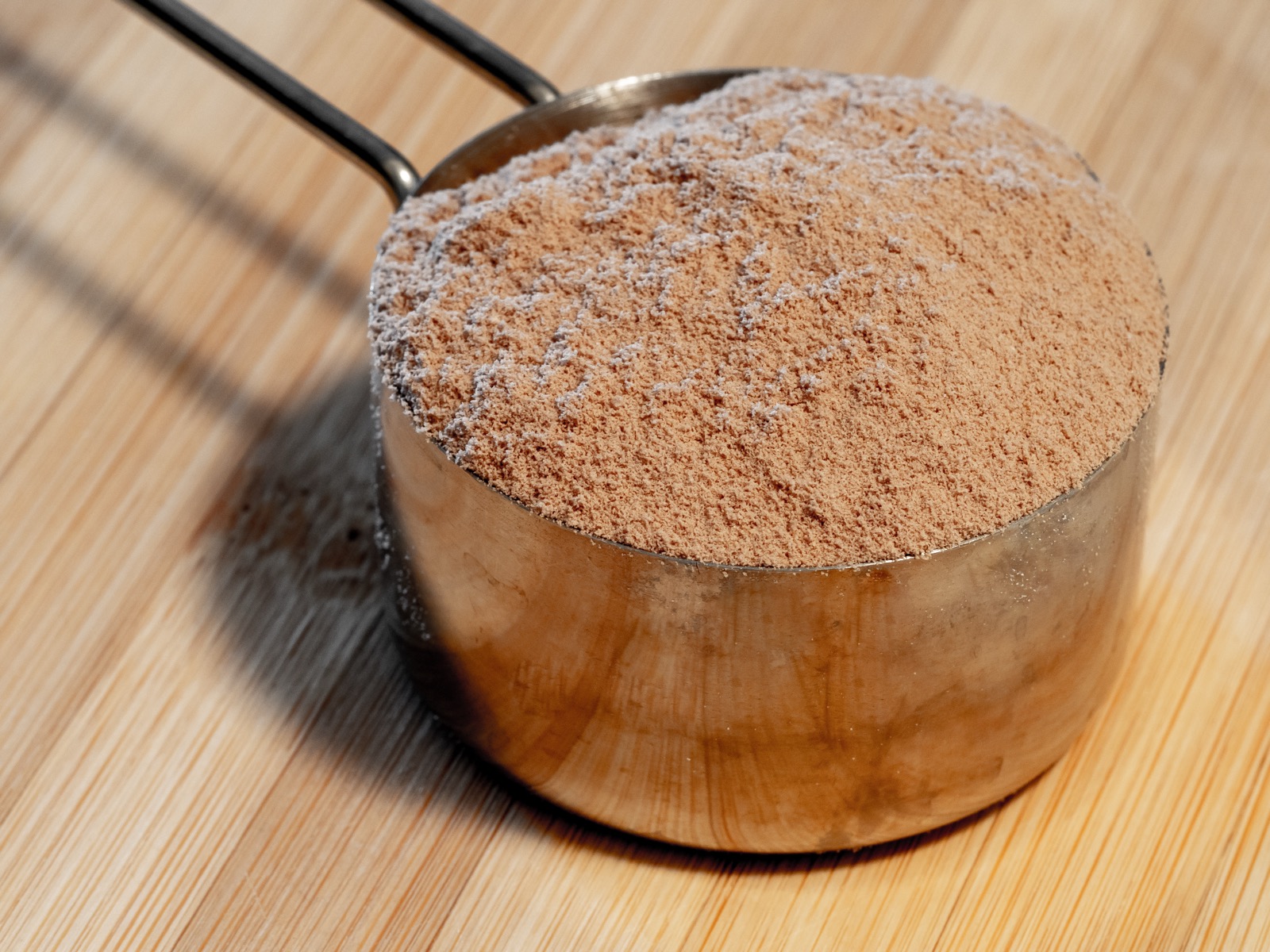
Egg white protein
Spray-dried hen egg albumen, desugarised and pasteurised, minimum 80% protein as-is and effectively fat-free. Foaming and heat-set gelling grades for bakery, confectionery and protein formats. Egg allergen.
Specifications
| Source | Hen (Gallus gallus) egg albumen, separated from yolk at the breaking line. Egg white only — no whole egg or yolk solids. |
| Protein content (dry basis) | Min 80% as-is, typically 82-84% (N x 6.25). USDA reference for stabilised glucose-reduced egg white powder: 82.4 g/100 g at 8.5% moisture, near 90% dry basis. |
| Appearance | Free-flowing white to pale cream powder; flake and granular cuts also made. Bland, neutral odour. Desugarisation keeps it from browning in storage. |
| Solubility | Fully water-soluble. Reconstitutes at roughly 1 part powder to 7 parts water to match liquid egg white, which is about 12% solids (USDA: 87.6 g water per 100 g). |
| Moisture | Max 8.0% typical trade spec; USDA reference powder 8.5%. Flake grade runs higher, near 14.6%. Confirm against the lot CoA. |
| Fat | Effectively fat-free — USDA reference powder 0.04 g/100 g. Yolk-free, so no cholesterol and no lecithin. |
| Ash | About 4.5-5.6% (USDA range for dried egg white). Sodium near 1,240 mg/100 g is native to the albumen, not added. |
| Particle size | Spray-dried. Supplied as fine powder, granular or flake by grade; sieve cut and bulk density agreed per contract. |
| Amino acid profile note | Complete protein, PDCAAS 1.0. Naturally high in sulphur amino acids. Milk-free, lactose-free and soy-free, which suits dairy-free protein formats. |
| Processing method | Albumen filtered, desugarised by fermentation or glucose oxidase-catalase to under ~0.1% free glucose, pasteurised, spray dried, then hot-room held near 54.4 C for 7-10 days. |
| Allergen status | EGG allergen. Declare as eggs and products thereof (EU 1169/2011 Annex II) and as egg (US FALCPA). Free of milk, soy and gluten; kosher pareve certification on request. |
| Functional properties | Foaming and heat-set gelation. Ovotransferrin denatures near 61-65 C, ovalbumin near 75-84 C, which sets the cook window for gelled systems. |
| Shelf life | Typically 24 months from manufacture, unopened, stored below 25 C at under 65% RH, away from strong odours and direct light. |
| HS code | 3502 11 00 (India ITC-HS) — egg albumin, dried. 18% GST domestically, export policy free. Not 2106 10 00; heading 0408 covers whole egg and yolk powder, not egg white. |
Applications
Available grades
Standard spray-dried egg white solids (min 80% protein as-is), high-whip grades for aerated confectionery and high-gel grades for binding and texturising. Available with or without permitted whipping aids — sodium lauryl sulphate is allowed at up to 1,000 ppm in egg white solids under 21 CFR 172.822 in the US, and triethyl citrate is also used; confirm what your destination permits. Fine powder, granular and flake cuts. Kosher (pareve) and Halal certification on request.
Related products
Whey Protein Concentrate (WPC)
Spray-dried bovine whey protein concentrate in WPC 34 through WPC 80 grades, made to ADPI composition — bland clean flavour, high hydration rate, gelation and acid stability for beverage, bar and dairy work.
Whey Protein Isolate (WPI)
Bovine whey protein isolate at 90–92% protein on dry matter, made by cross-flow microfiltration or ion exchange — near lactose-free, low fat, and clear in acid beverages at pH 3–4.
Whey Protein Hydrolysate (WPH)
Bovine whey protein hydrolysate produced by controlled enzymatic cleavage of WPC or WPI — a defined peptide mixture with higher solubility, lower viscosity and reduced heat gelation.