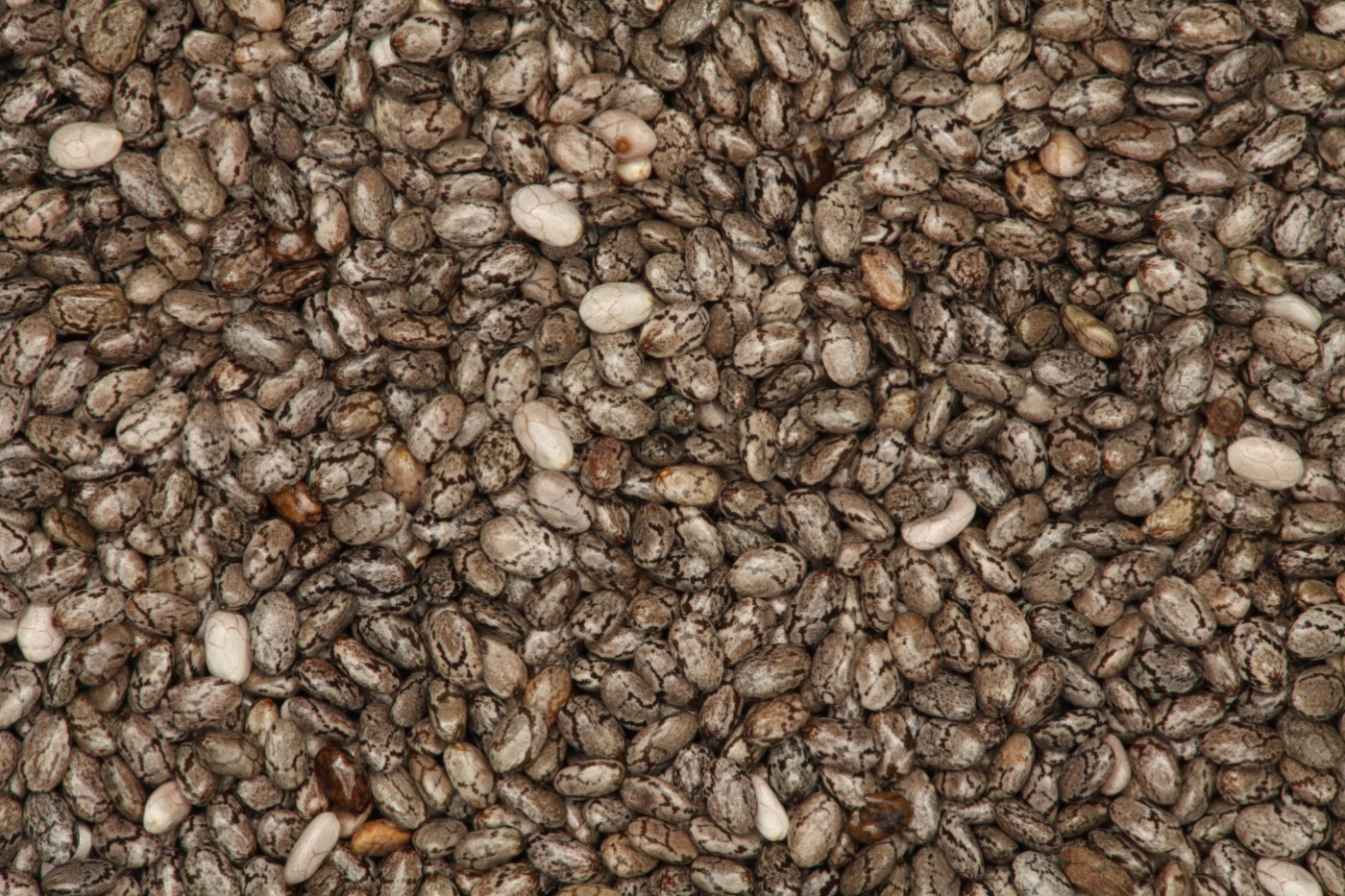
Chia seed oil
Cold-pressed chia seed oil from Salvia hispanica L., standardised to 60% minimum alpha-linolenic acid. Vegan, free of the major allergens, supplied as bulk oil or filled softgels.
Specifications
| Botanical identity | Salvia hispanica L. (Lamiaceae), seed. Not Salvia columbariae or other species also sold as chia. INCI name Salvia Hispanica Seed Oil |
| Extraction and grade | Virgin grade by mechanical cold pressing with seed held below 50 C, settled and filtered. No hexane, bleaching or deodorising. Refined winterised grade also offered |
| Alpha-linolenic acid (C18:3 n-3) | 60% minimum of total fatty acids; published profiles for cold-pressed chia oil give 61.1-63.6%. Assay by GC-FID of fatty acid methyl esters |
| Other fatty acids | Linoleic acid (C18:2 n-6) 17-20%, oleic acid (C18:1 n-9) 6-8%, palmitic 6-8%, stearic 2-4%. Total saturates below 12%. Omega-3 to omega-6 close to 3:1 |
| Appearance and solubility | Clear pale yellow to golden oily liquid, mild seed odour, no sediment at 20 C. Practically insoluble in water; miscible with vegetable oils and non-polar solvents |
| Acid value and free fatty acids | Maximum 4.0 mg KOH/g, the Codex CXS 210-1999 limit for cold-pressed and virgin oils; contract grades are usually written at 2.0 max (about 1.0% as oleic) |
| Peroxide value | Maximum 15 meq active oxygen/kg under Codex CXS 210-1999 for cold-pressed and virgin oils. Thovek releases at 5.0 max at pack to leave oxidation headroom |
| Moisture and unsaponifiable matter | Moisture and volatiles not more than 0.10%; unsaponifiable matter not more than 1.5%. Insoluble impurities not more than 0.05% |
| Physical constants | Refractive index 1.478-1.484 at 25 C; relative density 0.91-0.94 at 20 C; iodine value roughly 165-200 g I2/100 g depending on origin and method |
| Natural tocopherols and stabilisation | 480-600 mg/kg native tocopherols reported in chia oil. Mixed tocopherols, ascorbyl palmitate or rosemary extract dosed in line on request; nitrogen blanket standard |
| Allergen status | No milk, egg, soy, fish, crustacean, mollusc, gluten, cereal, peanut, tree nut, sesame, celery, mustard, lupin or sulphite input. Non-GMO, no irradiation |
| Origin and dietary status | Wholly plant-derived: vegan and vegetarian. No bovine, porcine or marine material in the oil. Bovine gelatin appears only if the buyer chooses a gelatin softgel shell |
| Shelf life and storage | 12 months in the unopened original pack below 20 C, protected from light and air; 24 months refrigerated. Use quickly once opened - the oil is roughly 80% polyunsaturated |
| HS code | 15159091 for edible grade bulk oil in India; 15159099 for cosmetic or non-edible grade; 21069099 for finished softgels. See the classification note |
Applications
Available grades
Virgin cold-pressed food grade as the base offer, plus a refined winterised grade with neutral odour and colour for beverage and bar systems, a certified organic grade (NPOP, NOP and EU equivalence), a cosmetic grade for topical formulation, and a tocopherol-stabilised grade for extended distribution. Finished softgels at 500 mg and 1,000 mg fill in bovine gelatin or vegetarian tapioca or HPMC shells. Kosher and halal certification on request.
Related products
Fish Oil (Omega-3)
Refined, deodorised fish body oil in natural triglyceride form, standard 18/12 grade (EPA 18% min, DHA 12% min). Ph. Eur. 1912 pharmacopoeial grade and softgel formats available.
Omega-3 Concentrate (EPA/DHA)
Molecularly distilled EPA/DHA concentrate from fish body oil, supplied as re-esterified triglyceride or ethyl ester in 33/22, 40/20, 50/20, 20/50 and 70% EPA grades.
Cod Liver Oil
Purified liver oil of wild cod (Gadus morhua), naturally supplying vitamin A 600-2500 IU/g and vitamin D3 60-250 IU/g to Ph. Eur. Cod-liver oil (Type A) and USP limits.