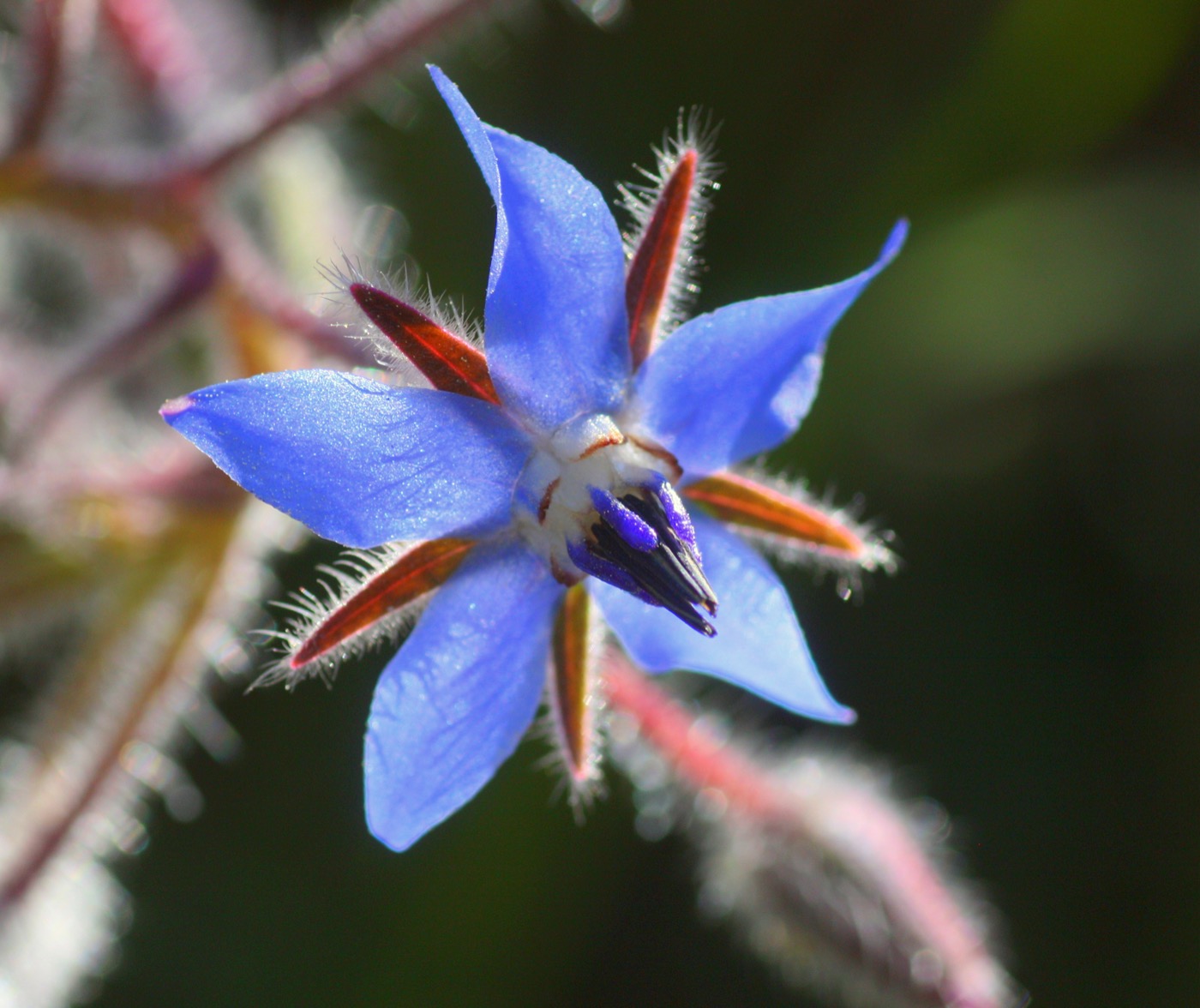
Borage Oil (Starflower Oil), GLA 20%
Borago officinalis seed oil at 20% minimum gamma-linolenic acid — roughly twice the GLA of evening primrose. Refined, pyrrolizidine-alkaloid tested, vegan, and dosed in smaller softgels.
Specifications
| Botanical source | Borago officinalis L., seed (starflower). INCI: Borago Officinalis Seed Oil |
| CAS number | 225234-12-8 — the record's 84012-16-8 is the WRONG entry for this product. 84012-16-8 is EC 281-661-4, the EINECS whole-herb extractives listing "Borago officinalis, ext.", which CosIng maps to the INCI entry Borago Officinalis EXTRACT (leaf/flower/herb material). The fixed seed oil has its own CAS Registry number, 225234-12-8 "Borage seed oil", which is what USP assigns to its Borage Seed Oil Reference Standard (USP-1076057) and what CosIng lists for INCI Borago Officinalis Seed Oil (CosIng ref 74513). Since this product is a refined seed oil standardised to GLA 20%, use 225234-12-8. Many supplier SDSs and catalogue listings (Sigma B1779 among them) do quote 84012-16-8 for borage seed oil, so the safest catalogue treatment is to lead with 225234-12-8 and cross-reference "EC 281-661-4 / 84012-16-8 (Borago officinalis, ext.)" for EU REACH and SDS continuity. Note the contrast with record 122: for evening primrose, CosIng assigns the OIL itself to 90028-66-3, so no equivalent change is needed there. |
| CAS No. | 225234-12-8 — the record's 84012-16-8 is the WRONG entry for this product. 84012-16-8 is EC 281-661-4, the EINECS whole-herb extractives listing "Borago officinalis, ext."… |
| Gamma-linolenic acid (C18:3 n-6) | ≥ 20.0% of total fatty acids guaranteed; typical 20–25%. Richest commercial plant source of GLA |
| Other principal fatty acids | Linoleic (C18:2) 35–42%; oleic (C18:1) 15–20%; palmitic (C16:0) 9–12%; stearic (C18:0) 3–5%; eicosenoic (C20:1) 3–5% |
| GLA delivered per softgel | At 20% GLA: 100 mg from a 500 mg fill, 200 mg from a 1,000 mg fill — about double the GLA of evening primrose oil per gram |
| Erucic acid (C22:1) | 1–4% naturally present. Borage oil retains a 50 g/kg EU maximum under Reg. (EU) 2019/1870, not the 20 g/kg general vegetable-oil limit |
| Pyrrolizidine alkaloids | LC-MS/MS tested per lot. Refining reduces PA by roughly four orders of magnitude; EU limits for botanical supplements apply under Reg. (EU) 2023/915 |
| Processing | Cold-pressed or pressed and refined (RBD). Not chemically modified. Refined grade recommended where PA control is contractual |
| Appearance and odour | Clear pale to light golden-yellow oil, free of sediment; refined grade bland and near-odourless |
| Free fatty acids and peroxide value | Refined: FFA ≤ 0.1% as oleic, PV ≤ 5 meq O₂/kg. Cold-pressed: FFA ≤ 2.0%, PV ≤ 10 meq O₂/kg. Lot values on COA |
| Allergen status | Vegan. Free of milk, egg, soy, fish, crustacean, molluscan, cereal gluten, peanut, tree nut, sesame, mustard, celery, lupin and sulphites |
| Seed origin and GMO status | Non-GMO. Seed contracted from Canada, the UK and Europe, China or New Zealand; pressed, refined and packed in India. Origin declared per lot |
| Shelf life and storage | 24 months refined, 18 months cold-pressed, unopened in sealed nitrogen-flushed containers below 20 °C away from light and heat |
| HS code (India ITC-HS) | 15159091 — other fixed vegetable oils, edible grade. Non-edible/cosmetic-only lots 15159099 |
Applications
Available grades
Cold-pressed unrefined; pressed and refined (RBD) food, supplement and pharmacopoeial grade; GLA ≥ 20% standard, higher-GLA lots subject to crop; certified organic to NPOP, NOP and EU standards subject to seed availability. Cosmetic grade to INCI declaration. Kosher and Halal certification available.
Related products
Fish Oil (Omega-3)
Refined, deodorised fish body oil in natural triglyceride form, standard 18/12 grade (EPA 18% min, DHA 12% min). Ph. Eur. 1912 pharmacopoeial grade and softgel formats available.
Omega-3 Concentrate (EPA/DHA)
Molecularly distilled EPA/DHA concentrate from fish body oil, supplied as re-esterified triglyceride or ethyl ester in 33/22, 40/20, 50/20, 20/50 and 70% EPA grades.
Cod Liver Oil
Purified liver oil of wild cod (Gadus morhua), naturally supplying vitamin A 600-2500 IU/g and vitamin D3 60-250 IU/g to Ph. Eur. Cod-liver oil (Type A) and USP limits.