Vitamin B12 (Methylcobalamin)
Methylcobalamin · C63H91CoN13O14P
The coenzyme methyl form of vitamin B12, supplied to USP specification at 98.0-102.0% assay as pure dark red crystals or as 0.1% and 1.0% triturations for sublingual and methylated B-complex blends.
Specifications
| Chemical name | Methylcobalamin (mecobalamin); Coα-[α-(5,6-dimethyl-1H-benzimidazol-1-yl)]-Coβ-methylcobamide |
| CAS number | 13422-55-4 |
| Molecular formula | C63H91CoN13O14P (Mr 1344.4) |
| Assay | 98.0% to 102.0% on the anhydrous basis (USP Methylcobalamin); JP mecobalamin specification available |
| Elemental cobalt | Approx. 4.4% by weight, calculated from the molecular formula |
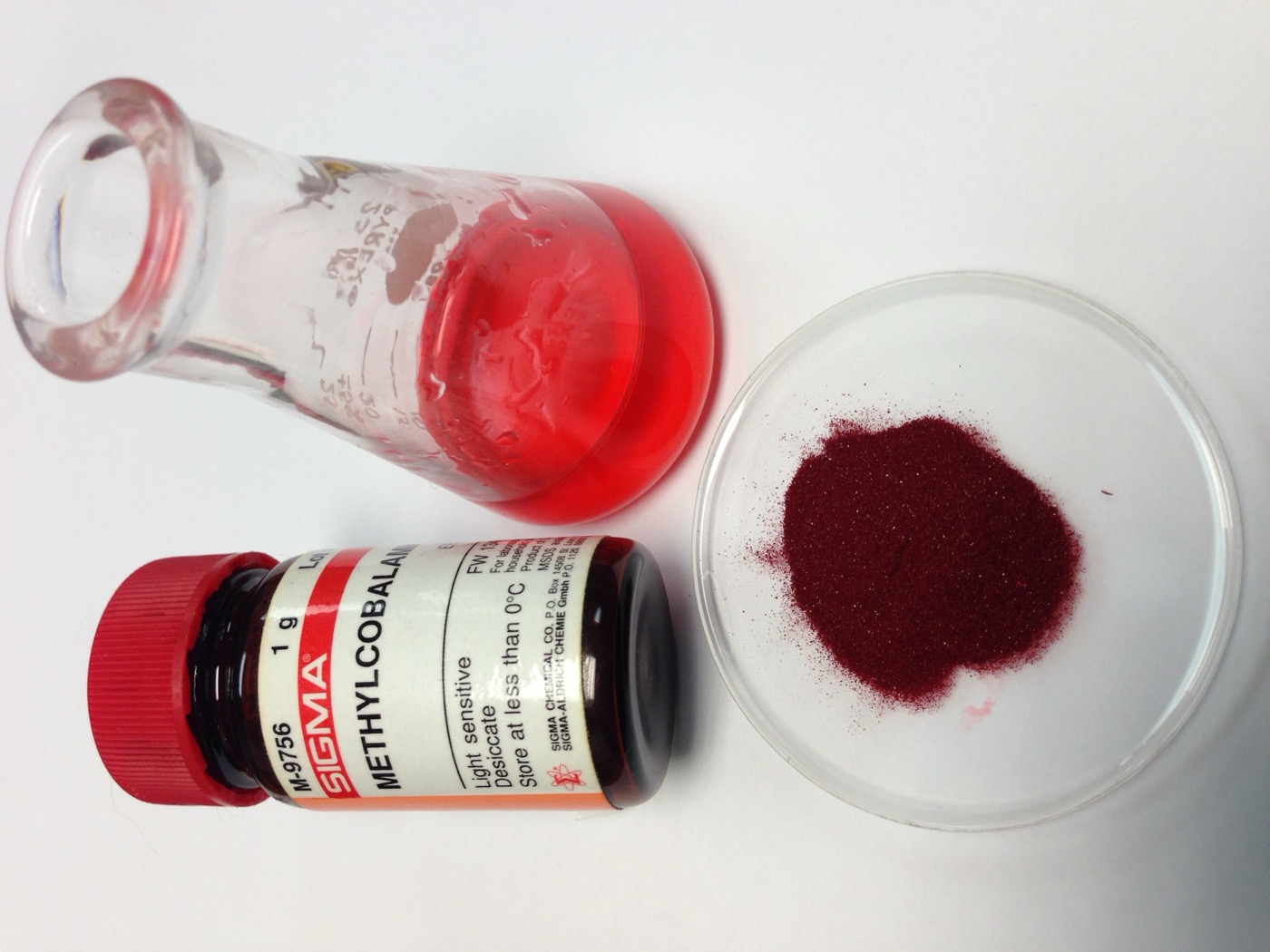
| Appearance | Dark red crystals or dark red crystalline powder; odourless; readily decomposed by light |
| Solubility | Sparingly soluble in water; slightly soluble in ethanol (99.5%); practically insoluble in acetone, acetonitrile and ether |
| Loss on drying | Not more than 12.0%; the substance is hygroscopic |
| Elemental impurities | Complies with ICH Q3D / USP <232>; lead, arsenic, cadmium and mercury values reported per batch |
| Forms and particle size | Pure crystalline, or 0.1% and 1.0% triturations on mannitol or dicalcium phosphate; free-flowing, typically 100% through 80 mesh, to buyer specification |
| Shelf life and storage | 24 months from manufacture in unopened, nitrogen-flushed original packing, below 25 °C, protected from light and moisture |
| HS code | 29362690 (India ITC-HS) |
Methylcobalamin, listed in the Japanese Pharmacopoeia as mecobalamin, is the coenzyme form of vitamin B12 in which a methyl group occupies the upper axial position on the cobalt atom in place of the cyanide ligand of cyanocobalamin (CAS 13422-55-4, C63H91CoN13O14P, Mr 1344.4). It is manufactured by reductive methylation of fermentation-derived cobalamin and isolated as dark red crystals containing approximately 4.4% elemental cobalt calculated from the molecular formula. Biochemically it is the cofactor of methionine synthase, the enzyme that transfers a methyl group to homocysteine in one-carbon metabolism, and formulators specify it where a pre-methylated cobalamin source is wanted in place of a form that the body must first convert.
Thovek supplies methylcobalamin against the USP Methylcobalamin monograph, which sets the assay at not less than 98.0% and not more than 102.0% calculated on the anhydrous basis, and against Japanese Pharmacopoeia mecobalamin requirements for buyers working to that standard. Compared with cyanocobalamin the material is markedly more hygroscopic and is readily decomposed by light, so it is milled, sampled, filled and shipped under subdued amber light with a nitrogen headspace, and finished dosage forms normally require opaque or amber packaging. Since the vitamin is dosed in micrograms, it is most often taken as a standardised 0.1% or 1.0% trituration on mannitol or dicalcium phosphate, which gives a free-flowing powder suited to sublingual tablets and lozenges, methylated B-complex blends, vegan and plant-based supplements, effervescent sachets and gummy bases. Pure crystalline material is available for pharmaceutical and analytical use.
Every lot is released against identity by HPLC and UV absorption, assay by HPLC, related substances, loss on drying of not more than 12.0%, residual solvents including acetone, elemental impurities to ICH Q3D and USP <232>, and full microbiological limits. Certificate of analysis, safety data sheet, and allergen, GMO and BSE/TSE statements accompany each shipment, with halal, kosher and GMP documentation on request. Material is despatched in light-tight, nitrogen-flushed packing on ISPM-15 heat-treated pallets with complete Indian export documentation.
Applications
Methylated B-complex supplementsSublingual tablets and lozengesVegan and vegetarian supplementsEffervescent and sachet formatsOral sprays and dropsNutraceutical gummiesVitamin premix blendingFunctional beverage fortificationPharmaceutical tablet manufacture
Available grades
USP, JP (mecobalamin), food and supplement grade; supplied pure or as 0.1% and 1.0% standardised triturations
Packaging: Pure crystalline material is filled under nitrogen into amber glass bottles or light-tight HDPE jars of 25 g, 100 g and 500 g, over-sealed in aluminium-foil laminate with desiccant and packed into fibreboard drums, while 0.1% and 1.0% triturations are supplied in 25 kg fibre drums with double food-grade LDPE liners; consignments ship palletised on ISPM-15 heat-treated pallets with certificate of analysis, safety data sheet and full export documentation.